_Kinetic Wall Sculptures

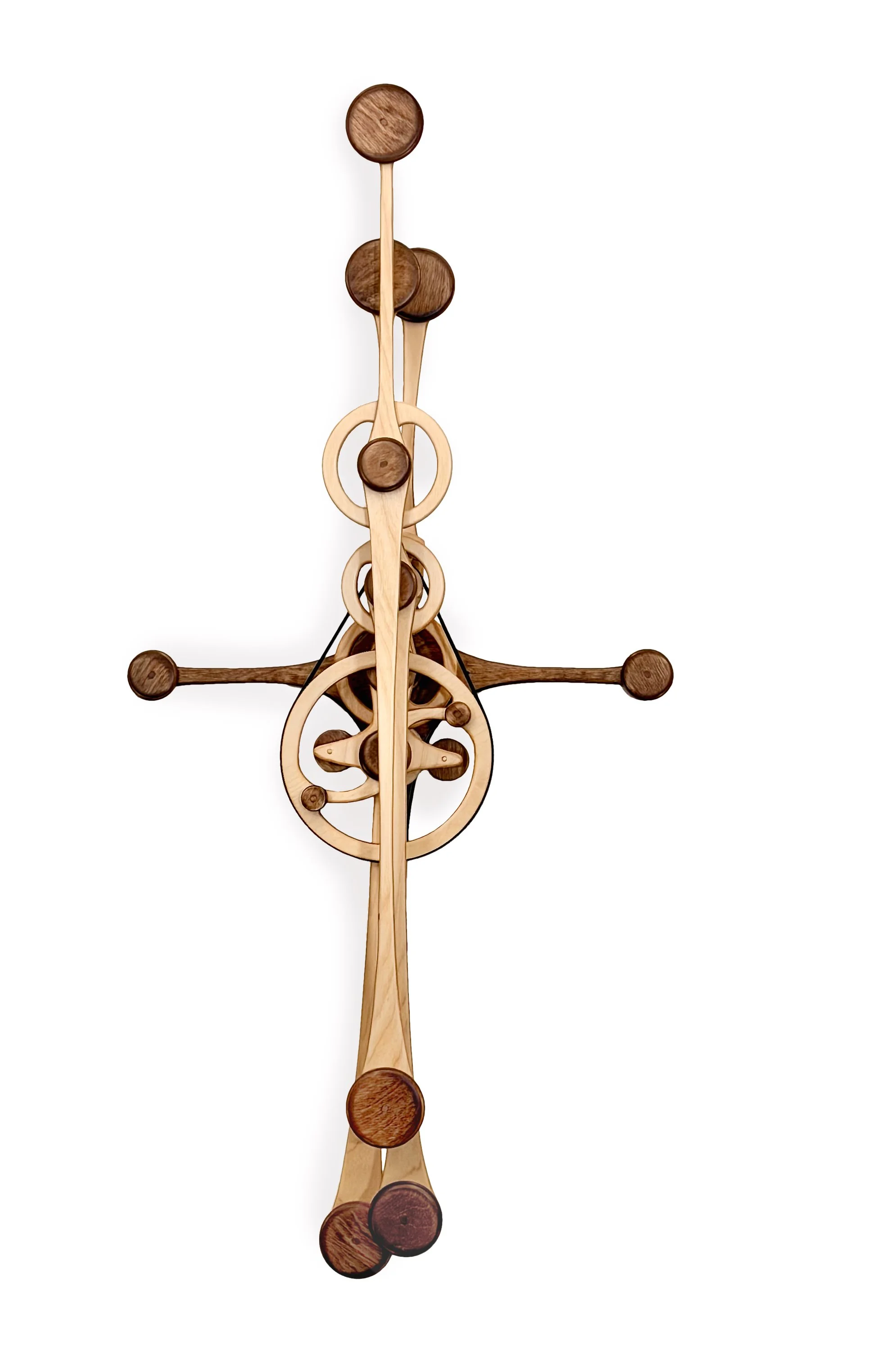
Fiddlesticks

Limited Edition of 12

  • Size: 68”w x 60” h x 10” d (maximum space needed for motion.) 12”w x 48”h when still.

  • Approximate Run Time: 6 hours +/-

  • Price: $6000 - opening bid

  • Sound: Makes soft, wooden clicking noises

  • Limited Edition of 12

  • MingleFiddlesticks © 2026

  • To Purchase

About Fiddlesticks:

For the past three years, I’ve been trying to push the boundaries of the chaotic motion I explored in my sculpture Chaos. I wanted to see what would happen if I introduced a third pendulum into the mix and I had no idea what to expect. I started simply: three straight pendulums stacked so the backmost pendulum supported the middle one, and the middle supported the front.
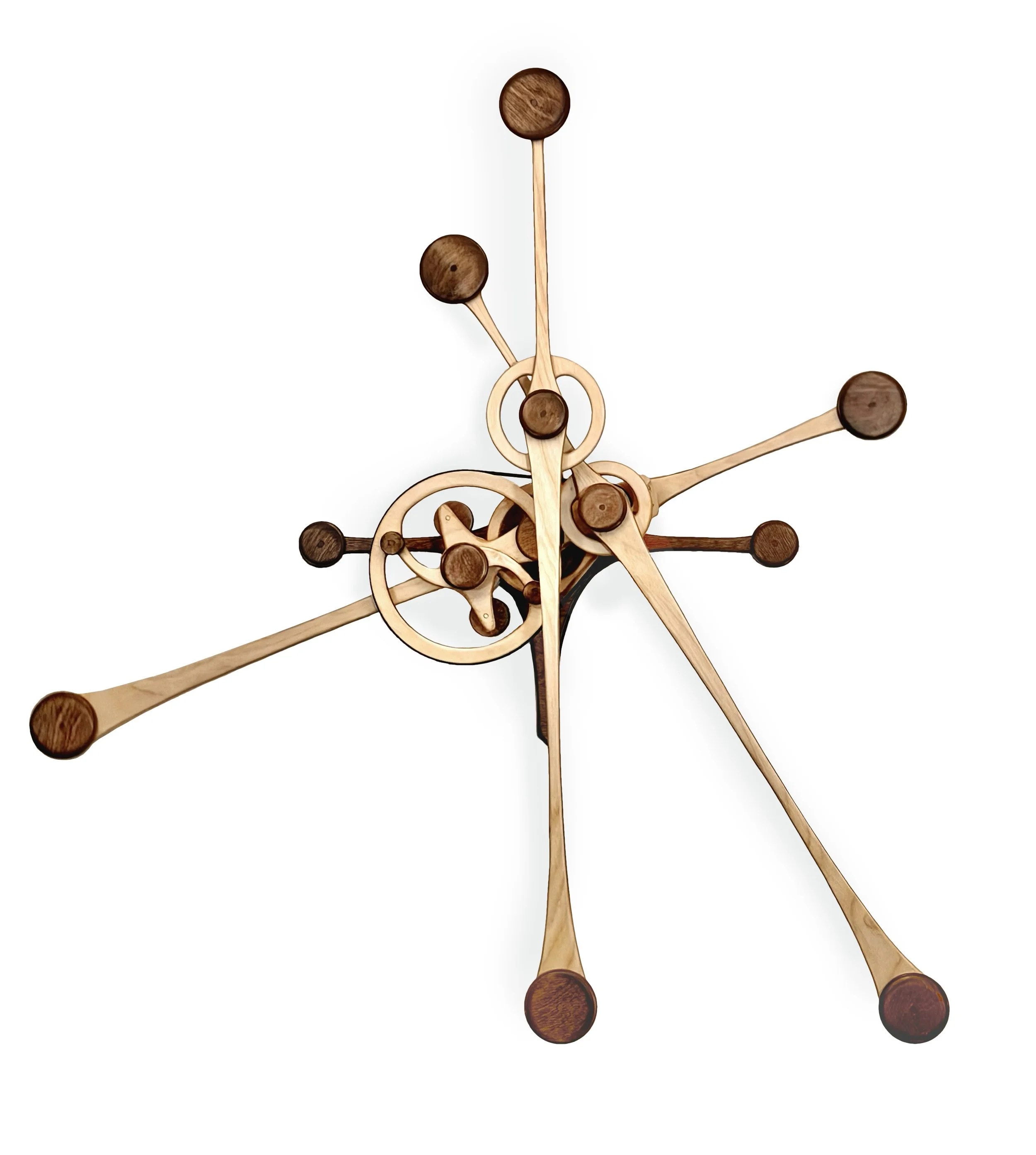
Then, I just played. I wasn’t entirely sure what I was looking for; I just wanted to observe. I swung the back pendulum through full 360º arcs and watched to see if the others would pick up the motion. I repeated this with each pendulum, studying how they reacted to one another.
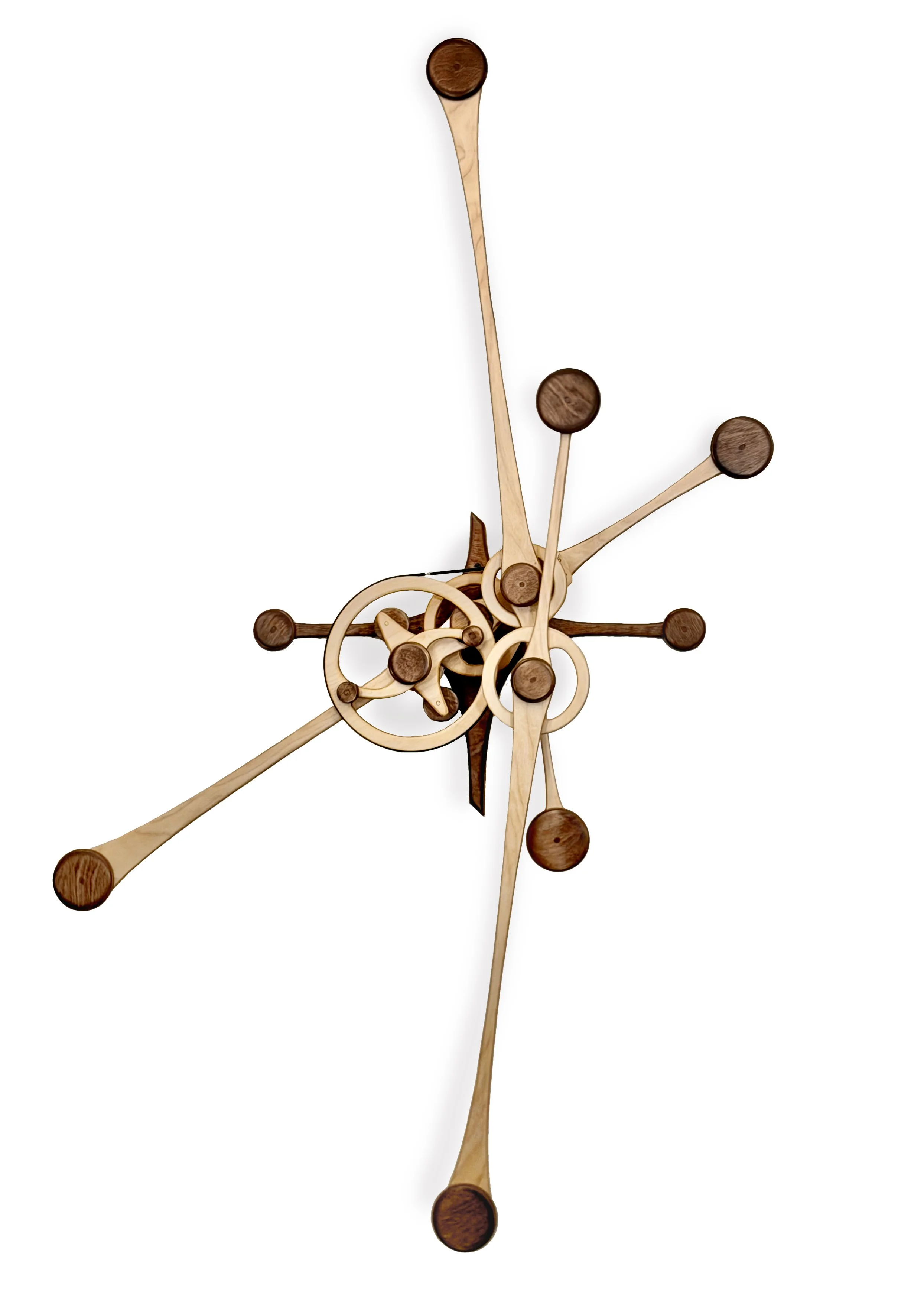
When I began making kinetic sculptures more than fifty years ago, I was happy just to create repeated motions. You can see this in my earliest pieces, like Serendipity. They were clock-like, even though my sculptures have never actually told time! Today, my goal is entirely different. I am looking for unpredictable, chaotic motion that possesses a natural, organic fluidity. During those initial experiments with the three pendulums, it was hard to describe exactly what I was seeing, but I knew there was a potential there worth exploring.

I added a spring-driven mechanism similar to the one I developed for Chaos and continued experimenting with different fulcrum lengths and balance points. Slowly, something fascinating began to emerge. The back and middle pendulums started transferring energy between themselves, engaging in a dynamic, back-and-forth dance as they reacted to gravity, momentum and the random inputs of spring energy.

The front pendulum then reacted to the relative motion of the two carrying pendulums behind it, almost like a child reacting to her parents. At times, it was incredibly active, swinging in large, energetic arcs like my youngest granddaughter when she simply needs to move. At other times, it rested almost completely still, just as she does when she finally sleeps.

Once I saw this interaction, the new challenge was figuring out how to sustain it without overpowering that delicate natural balance. I rebuilt the sculpture several times, refining the forms and shifting the balance points. I retuned the mechanism so it worked in harmony with the pendulums and gravity rather than against them. I lived with the sculpture in the studio, and brought it home so Marji and I could observe it in our daily lives, constantly tweaking and refining.

Melding natural gravitational motion with a subtle powering mechanism is a challenge that can only be met with time, patience, and careful observation. The result is Fiddlesticks, a piece that never repeats itself and always has something new to show you. I hope you enjoy watching its kinetic dance as much as I enjoyed bringing it to life.

Shasta Study - Diamonds 1

Specifications:

  • Size 30” in diameter

  • Approximate Runtime: 10 hours

  • One-of-a-kind

  • Shasta Study - Diamonds 1 ©2023

  • Sold

Introducing the Shasta Study Series

In 2016, I launched the Kindala series, which explored the hypnotic interplay of two patterning wheels rotating in unison at distinct, variable speeds. These sculptures revealed intricate patterns through slow, synchronized motion. Over subsequent years, I refined these designs using two mechanisms: the dependable center-wind system and the side-wind mechanism, where the spring and winder sit outside the patterning wheels. While the side-wind allows torque adjustment via pulley sizing, the center-wind’s fixed torque per spring “push” posed limitations—particularly for the delicate, unhurried motion central to Kindala.

Retirement has gifted me the freedom to tinker deeply. I have ample time to think, sketch, and experiment and I do. To address the center-wind’s rigidity, I theorized a “gearing down” solution: reducing torque through a cascade of compact pulleys. Though this risked increasing the winding effort (a potential annoyance), I forged ahead with a prototype. For testing, I repurposed lightweight Kindala wheels previously shelved due to their overly brisk movement under the old mechanism.

The experiment succeeded beyond expectations. Torque softened, yielding smoother, more deliberate patterns. While winding cycles jumped from 23 to 36 turns, the process proved effortless: a quick 20 manual spins followed by momentum-driven self-winding. This breakthrough unlocked new creative territory.

Emboldened, I designed patterning wheels once deemed impractical, culminating in Shasta. Along the way, I toyed with designs like Diamonds—initially envisioned as its own series—but the thrill of experimentation eclipsed my interest in mass production. Instead, I finished three unique Shasta Study sculptures for collectors, alongside Kindala Study - Galaxy, a fourth piece built with the original wheels that sparked this journey.

This series embodies the joy of problem-solving and the boundless curiosity that fuels my art—proof that constraints, when met with patience, can birth unexpected beauty.

Shasta Study - Diamonds 2

Specifications:

  • Size 30” diameter

  • Approximate Runtime: 10 hours

  • One-of-a-kind

  • Shasta Study - Diamonds 2 ©2023

  • Sold

Introducing the Shasta Study Series

In 2016, I launched the Kindala series, which explored the hypnotic interplay of two patterning wheels rotating in unison at distinct, variable speeds. These sculptures revealed intricate patterns through slow, synchronized motion. Over subsequent years, I refined these designs using two mechanisms: the dependable center-wind system and the side-wind mechanism, where the spring and winder sit outside the patterning wheels. While the side-wind allows torque adjustment via pulley sizing, the center-wind’s fixed torque per spring “push” posed limitations—particularly for the delicate, unhurried motion central to Kindala.

Retirement has gifted me the freedom to tinker deeply. I have ample time to think, sketch, and experiment and I do. To address the center-wind’s rigidity, I theorized a “gearing down” solution: reducing torque through a cascade of compact pulleys. Though this risked increasing the winding effort (a potential annoyance), I forged ahead with a prototype. For testing, I repurposed lightweight Kindala wheels previously shelved due to their overly brisk movement under the old mechanism.

The experiment succeeded beyond expectations. Torque softened, yielding smoother, more deliberate patterns. While winding cycles jumped from 23 to 36 turns, the process proved effortless: a quick 20 manual spins followed by momentum-driven self-winding. This breakthrough unlocked new creative territory.

Emboldened, I designed patterning wheels once deemed impractical, culminating in Shasta. Along the way, I toyed with designs like Diamonds—initially envisioned as its own series—but the thrill of experimentation eclipsed my interest in mass production. Instead, I finished three unique Shasta Study sculptures for collectors, alongside Kindala Study - Galaxy, a fourth piece built with the original wheels that sparked this journey.

This series embodies the joy of problem-solving and the boundless curiosity that fuels my art—proof that constraints, when met with patience, can birth unexpected beauty.

Shasta Study - Arcs 1

Specifications:

  • Size 30” diameter

  • Approximate Runtime: 10 hours

  • One-of-a-kind

  • Shasta Study - Arcs 1 ©2023

  • Sold

Introducing the Shasta Study Series

In 2016, I launched the Kindala series, which explored the hypnotic interplay of two patterning wheels rotating in unison at distinct, variable speeds. These sculptures revealed intricate patterns through slow, synchronized motion. Over subsequent years, I refined these designs using two mechanisms: the dependable center-wind system and the side-wind mechanism, where the spring and winder sit outside the patterning wheels. While the side-wind allows torque adjustment via pulley sizing, the center-wind’s fixed torque per spring “push” posed limitations—particularly for the delicate, unhurried motion central to Kindala.

Retirement has gifted me the freedom to tinker deeply. I have ample time to think, sketch, and experiment and I do. To address the center-wind’s rigidity, I theorized a “gearing down” solution: reducing torque through a cascade of compact pulleys. Though this risked increasing the winding effort (a potential annoyance), I forged ahead with a prototype. For testing, I repurposed lightweight Kindala wheels previously shelved due to their overly brisk movement under the old mechanism.

The experiment succeeded beyond expectations. Torque softened, yielding smoother, more deliberate patterns. While winding cycles jumped from 23 to 36 turns, the process proved effortless: a quick 20 manual spins followed by momentum-driven self-winding. This breakthrough unlocked new creative territory.

Emboldened, I designed patterning wheels once deemed impractical, culminating in Shasta. Along the way, I toyed with designs like Diamonds—initially envisioned as its own series—but the thrill of experimentation eclipsed my interest in mass production. Instead, I finished three unique Shasta Study sculptures for collectors, alongside Kindala Study - Galaxy, a fourth piece built with the original wheels that sparked this journey.

This series embodies the joy of problem-solving and the boundless curiosity that fuels my art—proof that constraints, when met with patience, can birth unexpected beauty.

Kindala Study - Galaxy

Specifications:

  • Size 30” in diameter

  • Approximate Runtime: 10 hours

  • One-of-a-kind

  • Kindala Study - Galaxy ©2023

  • Sold

Introducing the Shasta and Kindala Study Series

In 2016, I launched the Kindala series, which explored the hypnotic interplay of two patterning wheels rotating in unison at distinct, variable speeds. These sculptures revealed intricate patterns through slow, synchronized motion. Over subsequent years, I refined these designs using two mechanisms: the dependable center-wind system and the side-wind mechanism, where the spring and winder sit outside the patterning wheels. While the side-wind allows torque adjustment via pulley sizing, the center-wind’s fixed torque per spring “push” posed limitations—particularly for the delicate, unhurried motion central to Kindala.

Retirement has gifted me the freedom to tinker deeply. I have ample time to think, sketch, and experiment and I do. To address the center-wind’s rigidity, I theorized a “gearing down” solution: reducing torque through a cascade of compact pulleys. Though this risked increasing the winding effort (a potential annoyance), I forged ahead with a prototype. For testing, I repurposed lightweight Kindala wheels previously shelved due to their overly brisk movement under the old mechanism.

The experiment succeeded beyond expectations. Torque softened, yielding smoother, more deliberate patterns. While winding cycles jumped from 23 to 36 turns, the process proved effortless: a quick 20 manual spins followed by momentum-driven self-winding. This breakthrough unlocked new creative territory.

Emboldened, I designed patterning wheels once deemed impractical, culminating in Shasta. Along the way, I toyed with designs like Diamonds—initially envisioned as its own series—but the thrill of experimentation eclipsed my interest in mass production. Instead, I finished three unique Shasta Study sculptures for collectors, alongside Kindala Study - Galaxy, a fourth piece built with the original wheels that sparked this journey.

This series embodies the joy of problem-solving and the boundless curiosity that fuels my art—proof that constraints, when met with patience, can birth unexpected beauty.

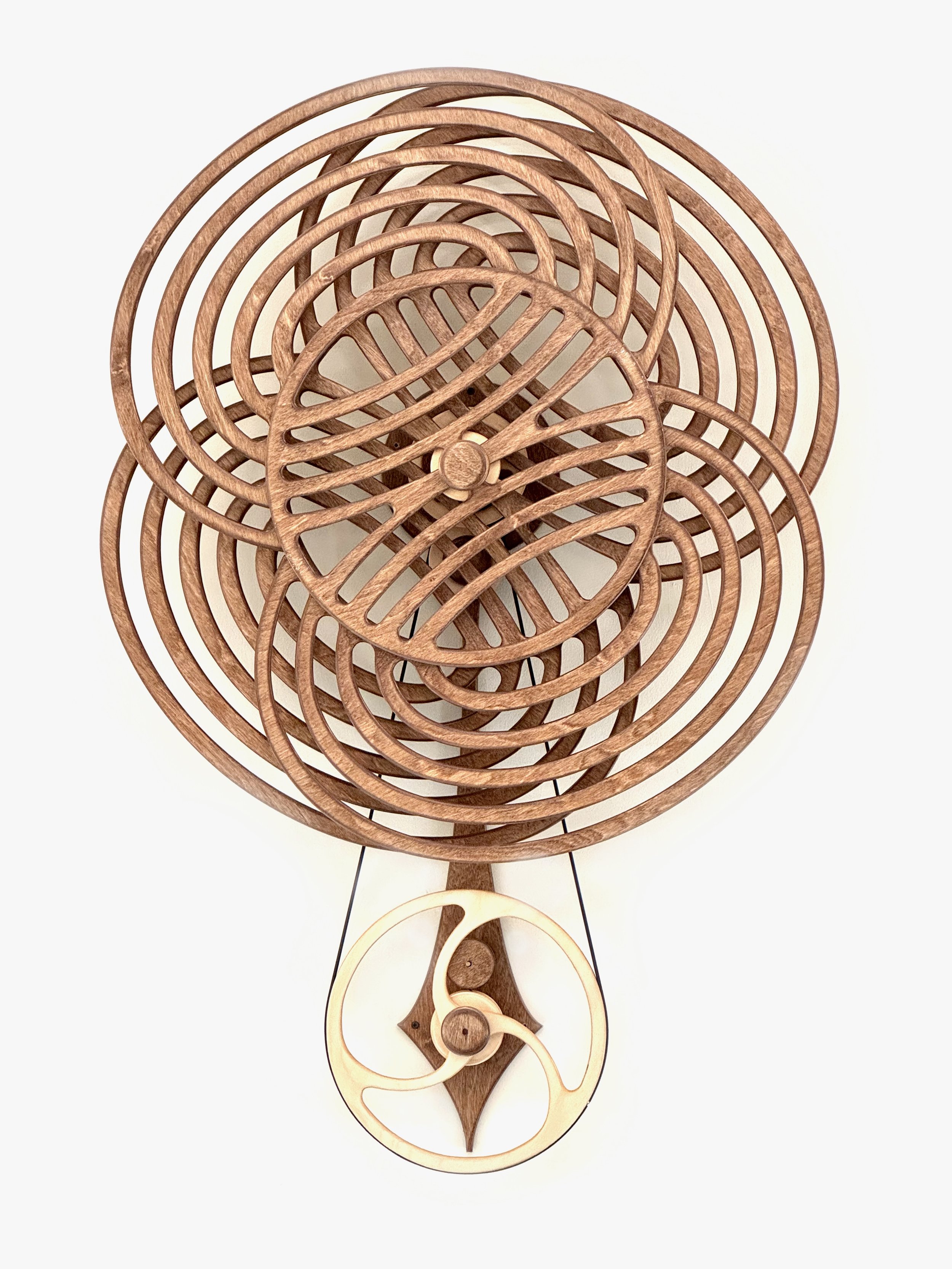
Mingle Study Arcs 1

Mingle Study Arcs 1 by David C. Roy of Wood That Works ©2023

Specifications:

Introducing the Mingle study series

One of the best aspects of being semi-retired is having ample time to experiment with new ideas. Instead of merely creating animations or rough prototypes, I can now build finished sculptures, eliminating the uncertainty of how they would function once completed. I took full advantage of this in my Mingle studies.

I initially utilized patterning wheels approximately the same size as those on my Boomerang sculpture. I employed the same base and mechanism because I was familiar with their mechanical capabilities. The patterns were indeed impressive, surpassing my expectations based on the animations. However, these sculptures were large, while I had many requests for designs that could fit on smaller walls. Now that I had the time I accepted the challenge. The patterns were essentially the same for both the large and smaller designs, but the mechanisms differed as I aimed to make the smaller one more compact but still have an extended runtime.

We have thoroughly enjoyed these sculptures in our home and gallery. Now, it is time to showcase and sell them to create space for the next set of studies.

Here are links to each of the five sculptures in this series.

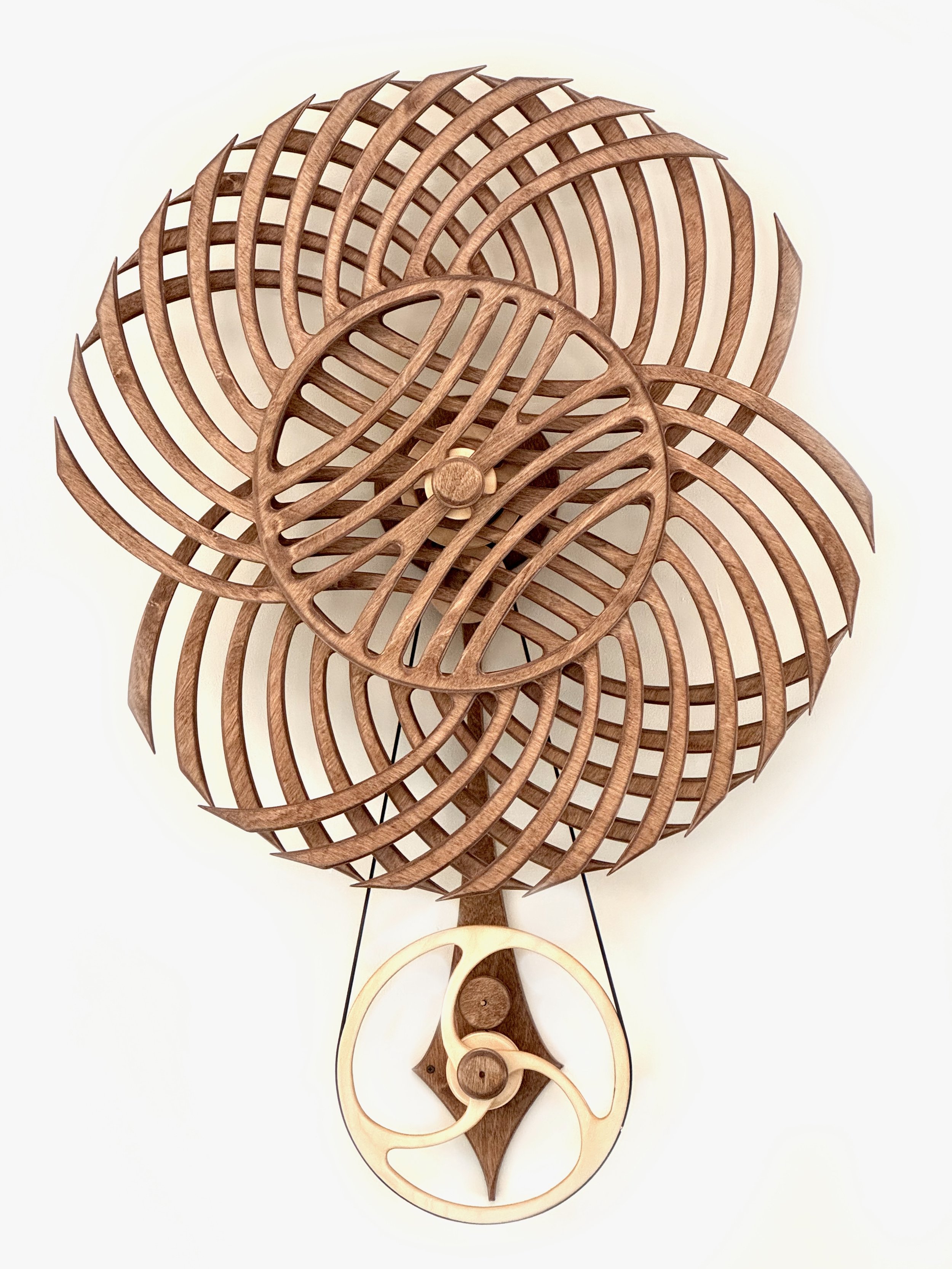
Mingle Study Fans 1

Specifications:

Introducing the Mingle Study Series

One of the best aspects of being semi-retired is having ample time to experiment with new ideas. Instead of merely creating animations or rough prototypes, I can now build finished sculptures, eliminating the uncertainty of how they would function once completed. I took full advantage of this in my Mingle studies.

I initially utilized patterning wheels approximately the same size as those on my Boomerang sculpture. I employed the same base and mechanism because I was familiar with their mechanical capabilities. The patterns were indeed impressive, surpassing my expectations based on the animations. However, these sculptures were large, while I had many requests for designs that could fit on smaller walls. Now that I had the time I accepted the challenge. The patterns were essentially the same for both the large and smaller designs, but the mechanisms differed as I aimed to make the smaller one more compact but still have an extended runtime.

We have thoroughly enjoyed these sculptures in our home and gallery. Now, it is time to showcase and sell them to create space for the next set of studies.

Here are links to each of the five sculptures in this series.

Mingle Study Series Fans 1 by David C. Roy of Wood That Works ©2023

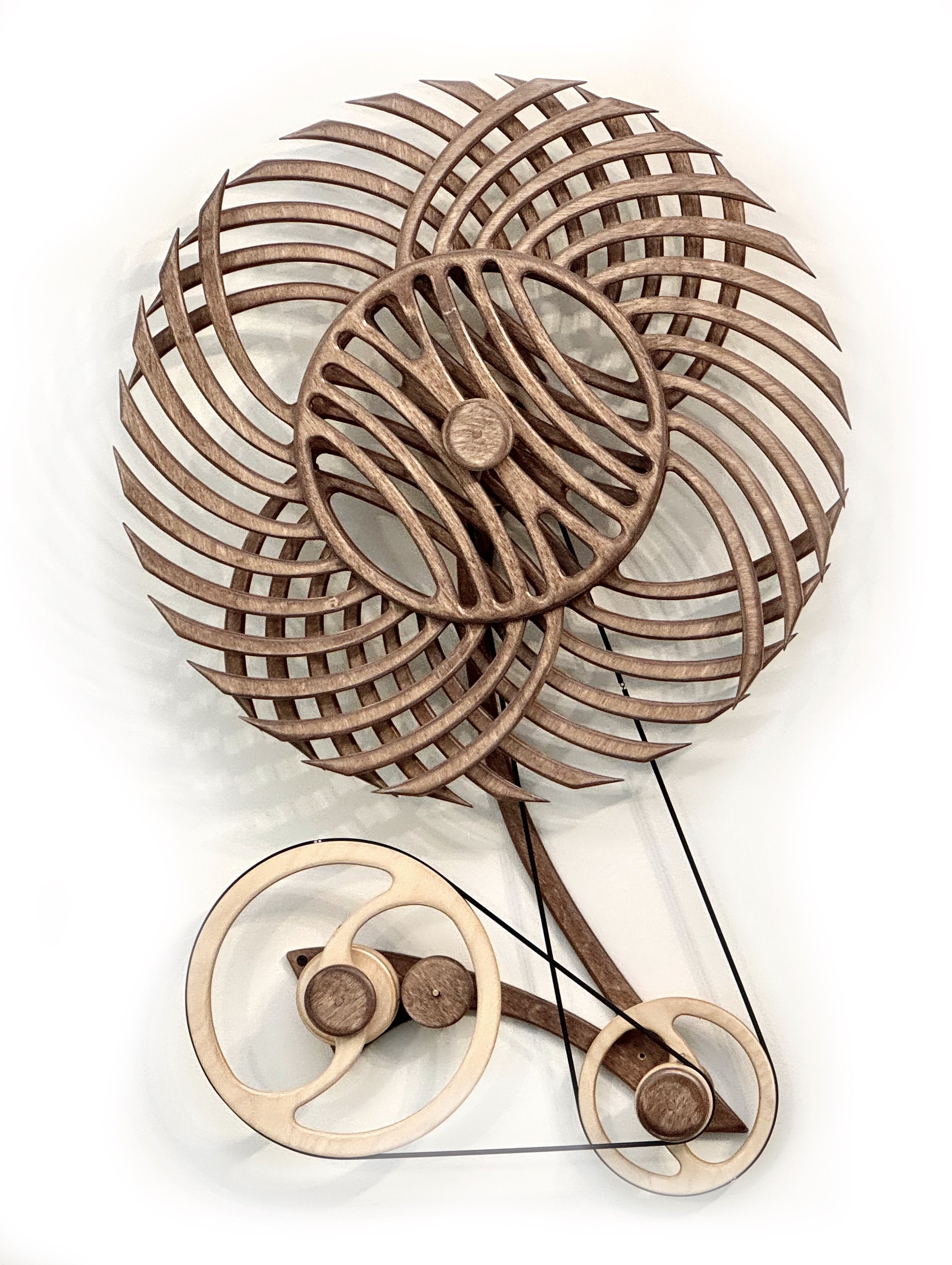
Mingle Study Fans 2

Specifications:

Mingle Study Fans 2 by David C. Roy of Wood That Works © 2023

Introducing the Mingle Study Series

One of the best aspects of being semi-retired is having ample time to experiment with new ideas. Instead of merely creating animations or rough prototypes, I can now build finished sculptures, eliminating the uncertainty of how they would function once completed. I took full advantage of this in my Mingle studies.

I initially utilized patterning wheels approximately the same size as those on my Boomerang sculpture. I employed the same base and mechanism because I was familiar with their mechanical capabilities. The patterns were indeed impressive, surpassing my expectations based on the animations. However, these sculptures were large, while I had many requests for designs that could fit on smaller walls. Now that I had the time I accepted the challenge. The patterns were essentially the same for both the large and smaller designs, but the mechanisms differed as I aimed to make the smaller one more compact but still have an extended runtime.

We have thoroughly enjoyed these sculptures in our home and gallery. Now, it is time to showcase and sell them to create space for the next set of studies.

Here are links to each of the five sculptures in this series.