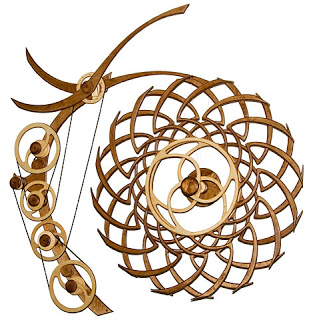
New Home for Seascape

I installed Seascape at the new Dansko corporate headquarters and retail outlet in West Grove, PA. in July. They were looking for a large one-of-a-kind sculpture for a protected area in the retail portion of their beautiful new building. The only sculpture I had that was nearly large enough was Seascape.

The installation went smoothly except for one minor glitch, I forgot to pack one knob. I had extras of everything else but no extra knobs. Marji and I had to drive to our daughter's house (about an hour away), steal a knob from her sculpture and drive back to Dansko. Fortunately it was a drive over pretty back roads. We used a GPS and explored several different routes. We stumbled on a Simon Pierce store and had a delightful lunch.

I like how the sculpture looks. I was afraid it might be too small but it fills the space nicely. The facility is beautiful with an open airy feel, many intriguing spaces and art pieces. It's worth a stop just to see the building and all the artworks.


The last Illusion

In June I made Illusion #36. This is the last of the Illusion edition I started in 2005. It is rewarding to finish an edition. The sense of completion, a job well done. It is also a bit sad. I get to know each of my sculptures intimately through the course of an edition. Each sculpture teaches me something new, design tweaks, construction techniques and most rewarding, ideas for new sculptures.

Constant force springs

There is some confusion about the "special springs" I use in my sculpture. The assumption is that they are a kind of spring motor that drives my sculptures at a constant slow rotational speed. What they actually provide is a constant rotational force or torque, not constant rotational speed. If the spring is not constrained in some way it will unwind very rapidly.


A traditional coiled clock spring gets "tighter" and provides greater torque the more you wind it. A constant force spring provides the same torque or turning force through out its cycle. You can find sources for constant force springs and much more information on their uses by doing a Google search on "constant force spring."

A good way to emulate a constant force spring is to attach a string to a freely rotating spool and hang a weight from the string. Wind the string up onto the spool, the torque or turning resistance you feel is pretty much the same as that from a constant force spring. If you release the spool the weight will drop and the spool will spin rapidly. You need to add a mechanism to control this rapid unwinding. My sculptures are essentially mechanisms to control the rapid unwinding of a spool. The general class of mechanism is called an escapement. Spring and weight driven clocks also use escapement mechanisms.


Clock escapements are designed run for long periods of time at a regular pace. I design my escapements/sculptures to produce visually interesting and sometimes random patterns. The important point to understand is that I don't power my sculptures with an escapement mechanism, my entire sculpture is an escapement mechanism.

Shipping and Journey


It turns out that with just a slight bit of modification to the way Journey is installed I can ship it in a much smaller box than I normally use. This will save a good bit on shipping expenses in today's high cost energy world. The cost of shipping my normal box to Europe has ballooned to something over $500 with added fuel surcharges. Journey, in this new box, will ship for less than $300.